Newton's second law, made practical
Find the missing force, mass, acceleration, and related values.
Enter the quantities you know. FISMA fills the rest using compatible SI units, so the relationships stay visible while you work.
Interactive calculator
Known values
Type numbers into any fields. Calculated fields are labelled automatically; edit a calculated value to make it one of your known values.
Formula sheet
Relationships used by this page
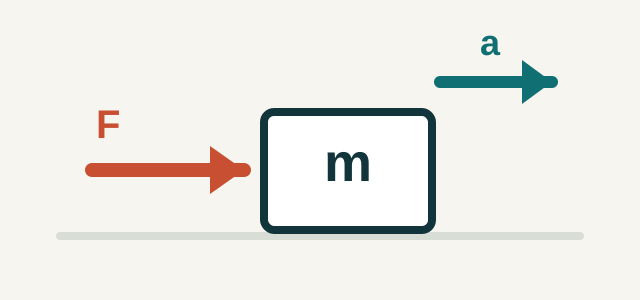
- F = maForce equals mass times acceleration.
- W = mgWeight is the force due to gravity.
- p = mvMomentum equals mass times velocity.
- J = FtImpulse equals force times time.
- E = FdWork equals force times distance.
- P = E/tPower equals work divided by time.
- P = FvPower can also be force times velocity.
- KE = 1/2 mv2Kinetic energy depends on mass and velocity squared.
Reference
Units and symbols
All calculations use SI units. The same letter can mean different things depending on context, so check the unit as well as the symbol.
- F
- Force, measured in newtons N.
- m
- Mass, measured in kilograms kg. A lowercase m can also mean metres when used as a unit.
- a
- Acceleration, measured in metres per second squared, m/s2.
- v
- Velocity, measured in metres per second, m/s.
- p
- Momentum, measured in kilogram metres per second, kg m/s.
- KE
- Kinetic energy, measured in joules J.
- g
- Gravitational field strength, measured in m/s2. Standard Earth gravity is 9.80665 m/s2.
- W
- Weight when used as a quantity, measured in newtons. As a unit, W means watt, the unit of power.
- t
- Time, measured in seconds s.
- J
- Impulse when used as a quantity, measured in newton seconds, N s. As a unit, J means joule.
- d
- Distance, measured in metres m.
- E
- Work or transferred energy, measured in joules J.
- P
- Power, measured in watts W. One watt is one joule per second.